American Heart Association Releases First Major CPR Guidelines Update in Five Years

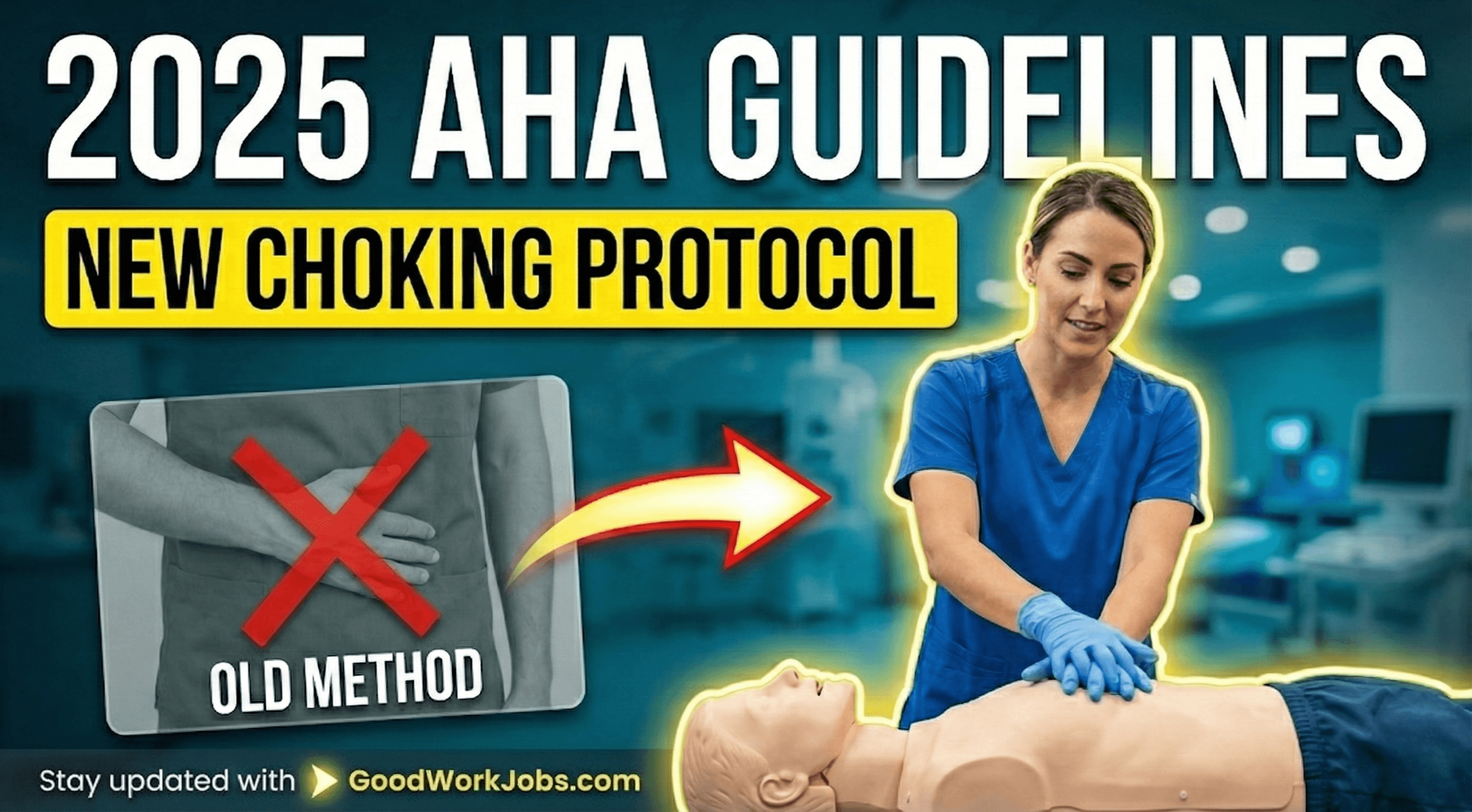
The American Heart Association published its 2025 Guidelines for Cardiopulmonary Resuscitation and Emergency Cardiovascular Care on October 22, 2025. This marks the first comprehensive revision of lifesaving resuscitation guidance since 2020.
The updated guidelines introduce significant changes to choking response, opioid overdose treatment, and how rescuers approach cardiac emergencies across all age groups. For healthcare workers and everyday people alike, these updates could mean the difference between life and death when seconds count.
What Changed and Why It Matters
The 2025 guidelines include 760 specific recommendations for adult, pediatric, and neonatal life support. Among the most significant changes is a new approach to helping choking victims.
For conscious adults and children with severe airway obstruction, rescuers should now alternate between five back blows and five abdominal thrusts. This pattern continues until the object is expelled or the person becomes unresponsive. Previous guidelines for adults did not include back blows at all.
Infant choking guidance also changed. Rescuers should now use five back blows followed by five chest thrusts with the heel of one hand. Abdominal thrusts are specifically not recommended for infants due to the risk of organ injury.
"The American Heart Association's 2025 CPR guidelines represent gold standard science," said Ashish Panchal, M.D., Ph.D., volunteer chair of the AHA Emergency Cardiovascular Care Science Committee. He emphasized that the guidelines reflect rigorous examination of the most current evidence guiding resuscitation for critically ill patients.
One Chain of Survival for Everyone
Perhaps the most fundamental structural change is the shift to a single Chain of Survival. Previously, there were separate chains for adults, children, and infants, as well as different versions for in-hospital and out-of-hospital cardiac arrests.
The unified chain now includes six links: recognition and emergency activation, high-quality CPR, defibrillation, advanced resuscitation, post-cardiac arrest care, and recovery and survivorship.
This simplification aims to make the messaging clearer for everyone. Whether you're a paramedic, nurse, or bystander at a restaurant, the core steps remain the same.
Addressing the Opioid Crisis
With opioid overdoses accounting for 80% of all drug overdose deaths worldwide, the guidelines now include a specific algorithm for responding to suspected opioid emergencies. For the first time, public access instructions explain when and how to use naloxone, the medication that can reverse opioid effects.
According to the AHA guidelines, signs of an opioid overdose include slow or absent breathing, choking or gurgling sounds, drowsiness or loss of consciousness, small pupils, and blue or grey skin coloring on the lips or nail beds.
The guidelines recommend that public policies allow for possession, use, and immunity from civil and criminal liability for good-faith administration of naloxone by lay rescuers. Naloxone distribution programs can help increase availability and decrease mortality from opioid-related overdoses.
New Guidance for Newborns
Working alongside the American Academy of Pediatrics, the AHA updated neonatal resuscitation recommendations. One notable change extends the recommended delay for umbilical cord clamping from 30 seconds to at least 60 seconds for term newborns who do not require immediate resuscitation.
Research shows this extended delay improves blood health and iron levels in infancy. For preterm infants born before 37 weeks who don't need immediate resuscitation, deferred cord clamping for at least 60 seconds is now specifically recommended.
Why Bystander CPR Needs to Improve
The statistics paint a sobering picture. According to American Heart Association data, approximately 350,000 people in the United States experience an out-of-hospital cardiac arrest each year. Around 90% of these cases are fatal.
Only about 41% of adults experiencing cardiac arrest outside the hospital receive CPR before emergency medical services arrive. Yet research consistently shows that early CPR can double or triple a person's chance of survival.
Data from the Cardiac Arrest Registry to Enhance Survival shows that survival to hospital discharge was significantly higher for patients receiving bystander CPR (13%) compared to those who did not (7.6%).
To address this gap, the 2025 guidelines recommend media awareness campaigns, increased instructor-led training, and expanded community training programs. Research also confirms that children as young as 12 can effectively learn CPR and defibrillation skills.
Key Updates for Healthcare Professionals
For medical professionals, several clinical recommendations changed significantly. The guidelines now recommend that health care professionals first attempt establishing intravenous access for drug administration during adult cardiac arrest, with intraosseous access as a reasonable backup if IV attempts fail.
Regarding mechanical CPR devices, the guidelines state that routine use is not recommended. However, these devices may be considered in specific settings where manual compressions would be challenging or dangerous for rescuers, as long as interruptions during deployment remain minimal.
Temperature control should be maintained for at least 36 hours in adult patients who remain unresponsive to verbal commands after return of spontaneous circulation. Hypotension should be avoided by maintaining a minimum mean arterial pressure of at least 65 mm Hg.
For pediatric patients, the guidelines now recommend maintaining systolic and mean arterial blood pressure greater than the 10th percentile for age after cardiac arrest. Evidence shows hypotension is common following return of circulation, occurring in 25% to 50% of infants and children.
Training and Implementation
The AHA and American Academy of Pediatrics are releasing updated CPR and ECC training materials simultaneously with these guidelines. The new resources will be translated and adapted for use in more than 90 countries.
Healthcare facilities should review the updated guidelines to provide necessary training for staff. Policies and procedures may need updating to reflect changes in choking response protocols, naloxone administration guidance, and the unified Chain of Survival approach.
"We know high-quality CPR saves lives, and we need dedicated support to ensure that everyone who needs high-quality CPR receives it," Panchal said. "That starts with learning it yourself. We encourage everyone to take a CPR class to learn the skills and techniques to provide life-saving care in an emergency."
Healthcare workers, how will these updated guidelines change your approach to emergency response? Will your facility be implementing new training protocols?
Sources
- American Heart Association: 2025 CPR Guidelines Press Release
- Circulation: 2025 AHA Guidelines Executive Summary
- American Heart Association: CPR Facts and Stats
- Sudden Cardiac Arrest Foundation: Latest Statistics from CARES 2024
Looking for your next healthcare opportunity? These guideline updates highlight how critical trained healthcare professionals are in saving lives. Whether you're a nurse, paramedic, or respiratory therapist, your skills matter.
Goodwork connects healthcare workers with transparent job opportunities that respect your expertise. See real pay ranges, honest job details, and find positions where your training makes the difference.